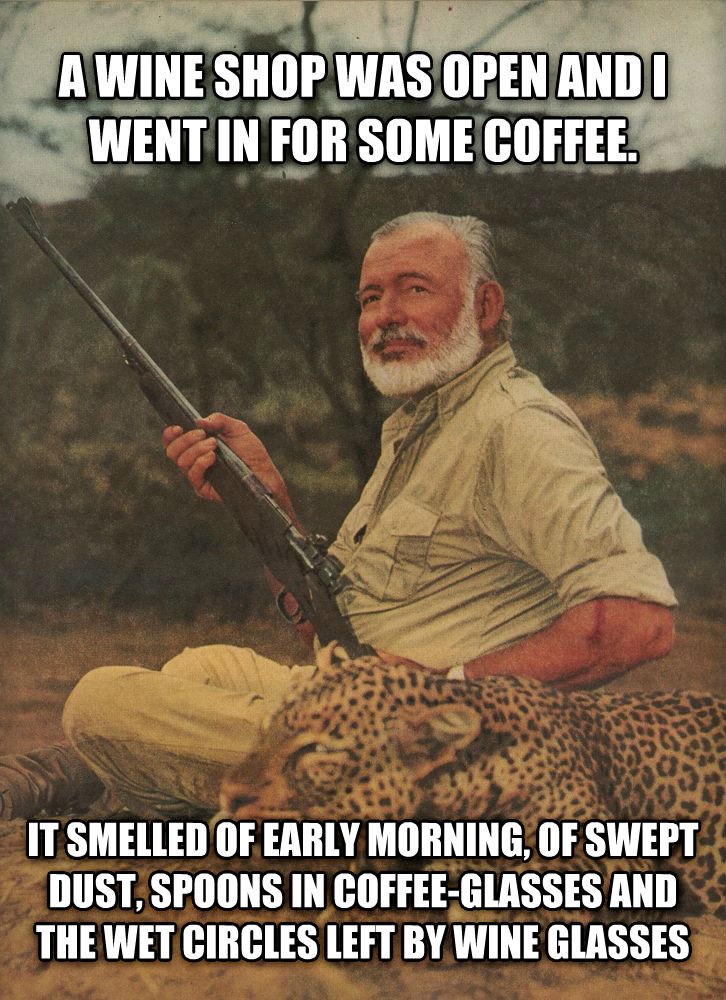
There is a new meme out there (well, perhaps it’s not new, but it is all over Facebook.) This meme encourages people to use the Oxford Comma. And while I don’t have particularly strong feelings about the Oxford Comma, the argument being made is that you must use it. I disagree with this, which is why I have decided to start my own rebuttal Oxford Comma meme: Hemingway Against the Oxford Comma.
My response is simple:

That’s it. A Hemingway quote, the work from which it came and the accompanying statement “Why I don’t use the Oxford Comma.”
There are a few other good ones I am about to generate as well, at the convenient website memegenerator.net. I encourage you to join me if you have been annoyed by this recent insistence that people are fools unless they use The Oxford Comma. Of course, this is nothing new. People like getting indignant about this, as evidenced by NPR and The Stranger and this website and Salon. I believe it is about time that a legitimate argument was staged against the Oxford Comma.
Or, there is the option of not caring about it, as evidenced here:

But seriously, let’s fight for the freedom of choosing, sentence by sentence, whether or not we will use the Oxford Comma. Let’s fight for Hemingway.

For the sake of clarity: I am not 100% against Oxford commas, and I am not saying that Hemingway was 100% against them, and I am not saying that you should be 100% against them. If one looks through Hemingway’s work, one will find he uses the Oxford comma more often than he does not.
However, one will also find that he does not use either option very often, as he rarely finds himself needing to use one or the other.
The Hemingway alternative to an Oxford comma situation is often something like this sentence from For Whom the Bell Tolls:
“Living was a horse between your legs and a carbine under one leg and a hill and a valley and a stream with trees along it and the far side of the valley and the hills beyond.”
Or try this on for a size, from A Farewell to Arms, in which he both uses and eschews the Oxford Comma: “Abstract words such as glory, honor, courage, or hallow were obscene beside the concrete names of villages, the numbers of roads, the names of rivers, the numbers of regiments and the dates.”
Are you confused? Am I? Is Hemingway? I don’t know. But here’s another: